Tuesday, October 09, 2007

Long ago you offered ...


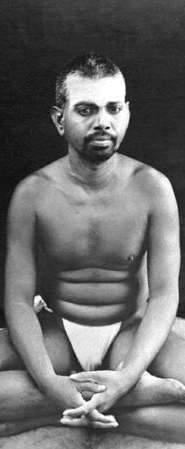
8. Long ago you offered your body, possessions and soul to me, making them mine,
so why do you still regard these things as 'I' and 'mine' and associate yourself with them?

See Arunachala Ramana.

Monday, October 08, 2007

I will show you the Light


9. Seek my grace within the Heart. I will drive away your darkness and show you the light.
This is my responsibility.

Arunachala Ramana

Sunday, October 07, 2007

True Practice of Sri Ramana's teachings

The true practice of Sri Ramana's teachings is remaining quiet, remaining in a state of inner mental quiescence that allows the power of Sri Ramana to seep into your heart and transform you. This can be summarized in one of Sri Ramana's classic comments: 'Just keep quiet. Bhagavan will do the rest.'

If you use the phrase 'practicing the teachings,' the following sequence is assumed: that Sri Ramana speaks of some goal that has to be attained, that he gives you some route, some practice, to reach that goal, and that you then use your mind to vigorously move towards that goal. The mind wants to be in charge of this operation. It wants to listen to the Guru, understand what is required, and then use itself to move in the prescribed direction. All this is wrong. Mind is not the vehicle one uses to carry out the teachings; it is, instead, the obstacle that prevents one from directly experiencing them. The only useful, productive thing the mind can do is disappear.

-- From Living the inspiration of Sri Ramana Maharshi

Saturday, September 08, 2007

Boundless love towards all beings

Just as a mother would risk her life
to protect her only child;
Similarly, one should cultivate
boundless love towards all beings.

-- Sutta Nipata 149 (Metta-suta)

Friday, August 31, 2007

Bhagavan Ramana and untouchability

When Bhagavan was living in Skandasramam I was once alone with him, sitting on the steps leading up to the Ashram, when a man came to the gate with his family and stopped and called out to me.

When i went there he asked me to ask the Swami whether they could approach him and receive his darshan. I was surprised and said: "Why do you ask permission?" And he said, "We are untouchables."

I started to go back to Bhagavan, but then it occurred to me that even to ask Bhagavan would be an injustice to him, so i told the man that caste had no meaning with Bhagavan and that they would be welcome. The whole party came and prostrated before Bhagavan, and I well remember how for about ten minutes his gracious look dwelt on that untouchable and his family; and how many rich and notable people have I seen fall at his feet without being vouchsafed such grace.

-- K.S.S. Ramanadasa

Thursday, August 30, 2007

Sadhu Natanananda's question in 1918

Sadhu Natanananda came to Sri Bhagavan for the first time in 1918. With the fervent wish of an earnest sadhaka, he climbed the hill to Skandasramam and besought thus:

It is my great desire that I should experience your gracious wisdom. Kindly fulfil my desire.

In those days Sri Ramana was not speaking much. Still he spoke kindly as follows:

"Is it the body in front of me which wished to obtain my Grace? Or is it the awareness within it? If it is the awareness, is it not now looking upon itself as the body and making this request?

If so, let the awareness first of all know its real nature. It will then automatically know God and my Grace. The truth of this can be realized even now and here."

Wednesday, August 29, 2007

Bhagavan Ramana Advent Day

Today is once again August 29th, anniversary of the day in 1896 when our beloved Lord, Bhagavan Ramana left his home for Arunachala (Tiruvannamalai).

He reached Arunachala on September 1st, a day now known as the Advent Day.

The following quotes from the Ashtavakra Gita are dedicated to the Supreme Lord, Bhagavan Ramana Maharshi.

Just as a mirror exists everywhere
both within and apart from its reflected images,
so the Supreme Lord (Arunachala Ramana) exists everywhere
within and apart from this body.

Just as one and the same all-pervading space exists
within and without a jar,
so the eternal, everlasting Ramana exists
in the totality of things.

At peace, having shed all desires within,
and realising that nothing exists here but Lord Ramana,
the Creator of all things,
one is no longer attached to anything.

Thursday, August 16, 2007

Egg production caused unbelievable cruelties


This link is not for the faint of heart. But if you eat eggs, i would be grateful if you would give it a read.

Egg production—including free-range and organic—involves multiple cruelties, such as the killing of 250 million newborn chicks each year in the United States.


Abundant undercover video footage shows bored or frustrated poultry slaughterhouse workers pulling the heads and wings off live birds, slamming them against a wall, and crushing them to death with their boots.

When you go vegan, it's a great feeling knowing you're eating as moral a diet as possible; that you're no longer making excuses or going into denial about unnecessarily contributing to the suffering and killing of animals; that you're no longer paying others to breed animals, manipulate their bodies, and kill them as soon as economically profitable.


Some people mistakenly think that there is no death involved in the egg business, but they are sadly mistaken. To begin with, for every laying hen there is a dead male chick. At some hatcheries, if the males are not thrown away to suffocate to death in trash containers, they are ground up alive, mixed with grain and fed to the females.

Please read this link: noeggs.org.

Update: This link has even more. Had no idea of the amount of killing that happens in egg-production! Please see this.

Much love to all of you.

Sunday, August 12, 2007

Self-enquiry for all people ?

The questioner: “Is it possible for all people to hold on to that path of Self-enquiry?”

Bhagavan: “It is true that it is only possible for mature minds, not for immature ones. For the latter, repetition of a prayer or holy name under one’s breath (japa), worship of images, breath-control (pranayama), visualising a pillar of light (Jyotishtoma) and similar yogic and spiritual and religious practices have been prescribed. By those practices, people become mature and will then realize the Self through the path of Self-enquiry. To remove the illusion of immature minds in regard to this world, they have to be told that they are different from the body. It is enough if you say, you are everything, all-pervading.

The Ancients say that those with immature minds should be told that they must know the transcendent Seer through enquiry into the five elements and reject them by the process of repeating, ‘Not this, not this (Neti, neti)’. After saying this, they point out that just as gold ornaments are not different from gold, so the elements are your own Self. Hence it must be said that this world is real.

See Letter 141.

Sunday, August 05, 2007

Mindfulness, Awareness

The bhikkhu who delights in mindfulness (awareness),
who sees danger in negligence,
is not likely to fall back.
He is in the presence of nirvana (enlightenment).

- Dhammapada 32

Tuesday, July 24, 2007

Hurting the Lord within us or within others

The following verses from the Bhagavad Gita confirm that hurting other living beings amounts to hurting none other than the Lord.

They who practice severe austerities without following the prescription of the scriptures, who are full of hypocrisy and egotism, who are impelled by the force of desire and attachment, who senselessly torture the elements in their body and also Me who dwells within the body, know these ignorant persons to be of demonic nature.
-- Bhagavad Gita (17.05-06)

See also: non-violence and Their suffering is mine.

Sunday, July 22, 2007

Seeing the Lord in all beings


He who sees the Supreme Lord, residing equally in
all beings -- the Imperishable One among the perishables -- sees (truly).
-- Bhagavad Gita xiii:27

See also: The Song Celestial v. 15

Friday, July 20, 2007

The Lord is in all

I am the Self, O Gudakesa*,
dwelling in the Hearts of all beings.
I am the beginning and the middle and the end of all beings.

-- Bhagavad Gita, X: 20

[* - Arjuna]

The Supreme Lord is situated in everyone's heart, O Arjuna,
and is directing the wanderings of all living entities,
who are seated as on a machine, made of the material energy*

-- Bhagavad Gita, XVIII: 61

[* Maya or illusion]

Please see The Song Celestial.

Wednesday, July 18, 2007

All is Self

O people who are longing and grieving so much, not knowing in the least the means to destroy the mind so that it will function no more, the means is to experience clearly that the seen (the world appearance) and the seer (the jiva) are nothing but oneself (the Self).

Like ornaments (seen) in gold, like water in a mirage, and like a dream city with battlements, everything that is seen is nothing but Self alone. To take them as being other than Self is wrong.

-- Guru Vachaka Kovai 922, 923

Wishing all readers joy on the anniversary of Bhagavan's enlightenment. Please see this and this..

Sunday, July 08, 2007

The nature of the mind - II

D.: So one need not seek to control the mind?

Maharshi: There is no mind to control if you realise the Self. The mind vanishing, the Self shines forth. In the realised man the mind may be active or inactive, the Self alone remains for him. For the mind, the body and the world are not separate from the Self. They rise from and sink into the Self. They do not remain apart from the Self. Can they be different from the Self? Only be aware of the Self. Why worry about these shadows? How do they affect the Self?

--Talk 97

Friday, July 06, 2007

Is knowledge of any use?

Is it any use reading books for those who long for release?

Bhagavan: All the texts say that in order to gain release one should render the mind quiescent therefore their conclusive teaching is that the mind should be rendered quiescent once this has been understood there is no need for endless reading. In order to quieten the mind one has only to inquire within oneself what one's Self is how could this search be done in books? One should know one's Self with one's own eye of wisdom. The Self is within the five sheaths but books are outside them.

Since the Self has to be inquired into by discarding the five sheaths, it is futile to search for it in books. There will come a time when one will have to forget all that one has learned.
--Collected Works - Who Am I?

Wednesday, July 04, 2007

The nature of the mind - I

D.: Mind always wanders. I cannot control it.

Maharshi: It is the nature of the mind to wander. You are not the mind. The mind springs up and sinks down. It is impermanent, transitory, whereas you are eternal. There is nothing but the Self. To inhere in the Self is the thing. Never mind the mind. If its source is sought, it will vanish leaving the Self unaffected.
--Talk 97

Tuesday, July 03, 2007

The nature of the mind

What is called `mind' is a wondrous power residing in the Self. It causes all thoughts to arise. Apart from thoughts, there is no such thing as mind. Therefore, thought is the nature of mind. Apart from thoughts, there is no independent entity called the world. In deep sleep there are no thoughts, and there is no world. In the states of waking and dream, there are thoughts, and there is a world also.

Just as the spider emits the thread (of the web) out of itself and again withdraws it into itself, likewise the mind projects the world out of itself and again resolves it into itself. When the mind comes out of the Self, the world appears. Therefore, when the world appears (to be real), the Self does not appear and when the Self appears (shines) the world does not appear. When one persistently inquires into the nature of the mind, the mind will end leaving the Self (as the residue). What is referred to as the Self is the Atman.
--Collected Works - Who Am I?

Monday, July 02, 2007

Prophet Muhammad - compassion, love, non-violence

Today, we present some inspiring snippets from the life of Prophet Muhammad.

The Islamic Prophet led a life of simplicity and poverty. His house, built of mud walls and thatched with date-palm leaves, often remained dark for want of oil for the lamp. At times he did not even have the flour with which to prepare bread.

When he grew up he earned a great reputation for his honesty and integrity. He always fulfilled his promises. Because he was extremely trustworthy, he became known as Al-Amin.

While Mohammed was serving a sick slave, the latter asked, "Has my master sent you to look after me ?"
"Yes," said Mohammed, "the master of masters has sent me to serve you."

One day, a dying dog approached a follower of Mohammed. The man had no means with which to procure water for the dog, for wells in the desert dry up quickly. He noticed a small pool of muddy water in the vicinity. He tore his shirt, soaked it in the water, placed the dog in his lap and moistened its mouth with the wet cloth. Another Arab who saw this went to the Prophet and said, "One of your followers has touched a filthy animal, a dog, and should therefore not be allowed back here again."

Mohammed questioned, "What was he doing to the dog ?"

"I do not know, but I saw him moistening its mouth with a torn piece of cloth dipped in muddy water," replied the man.

"He is a better Muslim than you are, because he is kind to animals," said the Prophet.

When Mohammed was in Mecca once, a poor shepherd from the hills came to worship in the mosque. He worshipped in his own simple way, performing the necessary ablution, kissing the stone and bowing before the sacred spot. Tears flowed from his eyes as he prayed:

 "O adorable Lord of love, show me Thy face. Let me be thy servant. Let me mend Thy shoes, apply oil to Thy hair, wash Thy soiled clothes and bring Thee daily the milk of my goat. Let me kiss Thy hand and shampoo Thy sacred Feet. Let me sweep Thy room."

Such simple words of the honest and straightforward shepherd offended the priests who stood near him. They said to him, "What blasphemy is this ? There is no need of such gifts for the omnipotent Lord."

They were ready to drive him out of the temple, when the Prophet called them to him and asked, "When you are in distant lands, in which direction do you turn your faces ?"

"We turn our faces to Mecca," they answered in reply.

He further asked, "When you are within this sacred walls, in which direction do you turn your faces ?"

"All is holy here," they replied. "It does not matter which way we turn."

The Prophet then said, "Your answer is beautiful indeed. Within the mosque it does not matter how you pray, as long as you have love and reverence. This poor shepherd's simple prayer entered directly into the ears of Allah more clearly than yours, as it was uttered from his heart with intense love, faith, sincerity and reverence. Make room for God's poor lover near me. Let no one be ashamed to have his company. He is humble, pure and an exalted soul."

Mohammed had great compassion and love. He served the widows and orphans, the poor, sick, aged and homeless. Once, he met an old, impoverished widow. Mohammed said to his wife, "My beloved, give food to this old woman first and then you may eat."

When the Prophet saw a blind woman stumbling in the street in Mecca, he led her gently home and thereafter took meals to her daily.

One day, he saw a woman with a heavy load on her head. At once he relieved her of her burden and carried it on his own head to her house.

Mohammed was humble and simple. Although he was a Prophet with a large following he worked along with others like an ordinary labourer during the construction of the first mosque at Medina. He mended his own shoes, milked the cows, swept the house, purchased provisions, tethered and fed the camels. He never laughed loudly but simply smiled. He had an attractive face and a charming smile. He respected the poor and restored freedom to many slaves.

The holy Koran, divided into more than one hundred chapters, opens and ends with the subject of the unity of God. The religion of Islam is essentially a religion of peace, for Mohammed was a lover of peace and non-violence. (Complete article)

Sunday, July 01, 2007

Worshipping the form of God

Let those who have become a prey to the delusion of action, being unable to follow the original path of the light of Self, existence-consciousness, worship the form of their beloved God. Then they will gradually lose their delusion (towards names and form and action) and finally attain the Supreme Self.
--Guru Vachaka Kovai, Sri Muruganar.